Search "best time to post on TikTok" and you will find a dozen confident charts that all disagree with each other. That is a clue worth paying attention to. There is no single universal posting time that works for every account, because TikTok's For You feed serves your videos based on watch behavior over hours and days, not just the minute you hit publish.
That said, posting timing still matters at the margins, especially early in a video's life. This guide covers the general windows that tend to perform on TikTok in 2026, then shows you how to find the times that actually work for your specific audience, which is the only schedule that really counts.
Why posting time matters less than people think
TikTok is not a chronological feed. Unlike platforms where a post mostly reaches people who are online right now, TikTok keeps testing your video with new viewers for hours and sometimes days after you publish. A clip can sit quietly for a day and then pick up if early watch signals are strong. That long testing window softens the impact of any single "perfect" posting minute.
What timing does influence is the first push. When you post while a meaningful slice of your audience is active, you can earn early views, watch time, and engagement faster, and those early signals help TikTok decide whether to show the video to more people. So timing is a nudge, not a lever. It can help a good video get tested sooner, but it will not rescue a video people scroll past.
General posting windows that tend to work
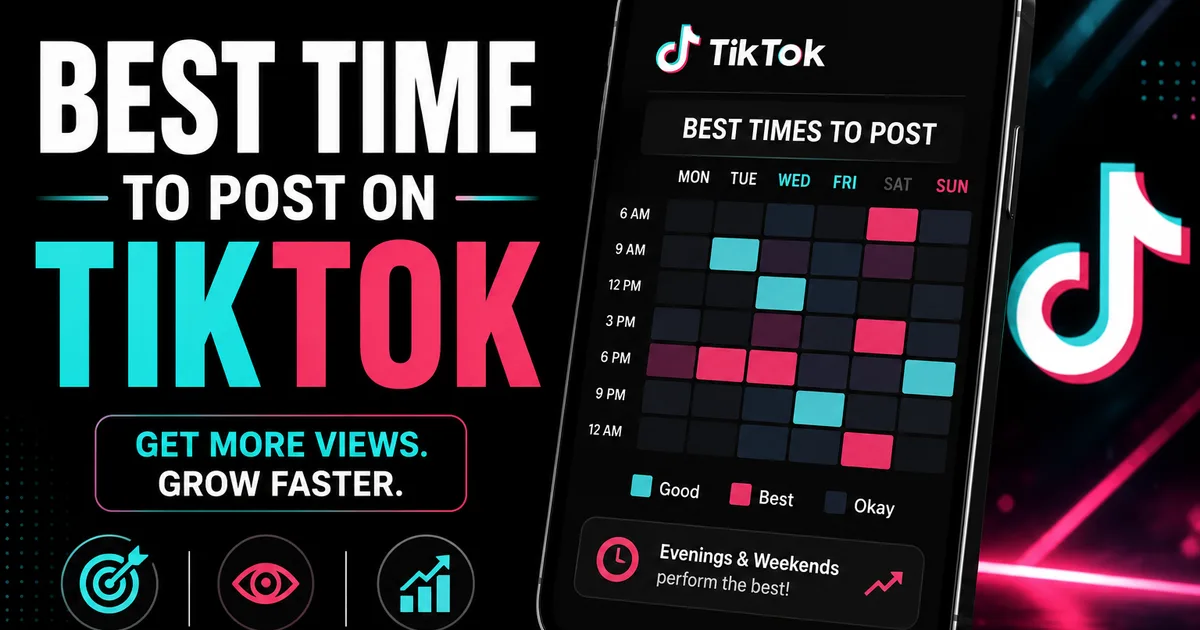
Across many creators, engagement tends to cluster around the parts of the day when people are taking breaks: mid to late morning, the lunch hour, the early evening commute or wind-down, and later at night. These are tendencies, not rules, and they shift by audience and time zone. Treat the list below as a starting point to test, not a guarantee.
Importantly, all of these depend on where your audience actually is. If most of your viewers are in a different time zone than you, post to their clock, not yours. A creator in California with a mostly European audience should be thinking in European evening hours.
- Weekday mornings, roughly 9–11 a.m. local to your audience
- The midday break around lunch
- Early evening, roughly 6–9 p.m., when scrolling tends to rise
- Later night hours for entertainment and younger audiences
- Weekends can run later and more spread out across the day
How to find YOUR best time (the part that matters)
Generic charts are a stand-in until you have your own data, and you can get that data for free. Switch to a Business or Creator account in TikTok settings, then open your analytics. The Followers tab shows when your followers are most active by day and hour. That is the single most useful signal for timing, because it reflects your audience, not a global average.
From there, run a simple experiment. Pick two or three candidate windows from your follower-activity data, post comparable videos in each over a couple of weeks, and watch which slots earn faster early views and better completion. Keep what wins and drop the rest. Because your audience and content evolve, it is worth repeating this check every few months.
- Switch to a Business or Creator account to unlock analytics
- Check the Followers tab for active days and hours
- Test 2–3 windows with similar videos over a couple of weeks
- Compare early views and watch-through, then keep the winners
- Re-check seasonally as your audience shifts
What beats timing every time: the video itself
If you only optimize one thing, optimize the first two seconds. TikTok decides quickly whether to keep pushing a video, and a weak opening loses viewers before the algorithm ever gets a strong signal. A sharp hook, clear payoff, and good watch-through will outperform a perfectly timed post that does not hold attention.
Consistency is the close runner-up. Posting on a steady rhythm gives TikTok more chances to learn what your content is and who enjoys it, and it keeps you in front of the followers you already have. A reliable cadence at a decent time will beat sporadic posting at a theoretically ideal one.
Where a views boost fits in
Some creators add a view boost to a fresh upload to put a bit of early social proof on the counter as the video starts circulating. A higher view count can make a clip look more worth watching to the new people who land on it, which is the same reason timing matters. It is about the early impression.
Be clear-eyed about the limits. Extra views do not control the For You algorithm, force watch time, or guarantee that a video takes off. BoostHill delivers TikTok views from genuine sources using only your public video link, with no password required and a refill guarantee. Use it as a complement to a strong hook and consistent posting, not a substitute for either.
Frequently asked questions
Read next: How Much Does TikTok Pay Per View in 2026?. For more, browse our TikTok guides or all posts by Jessica Adler.