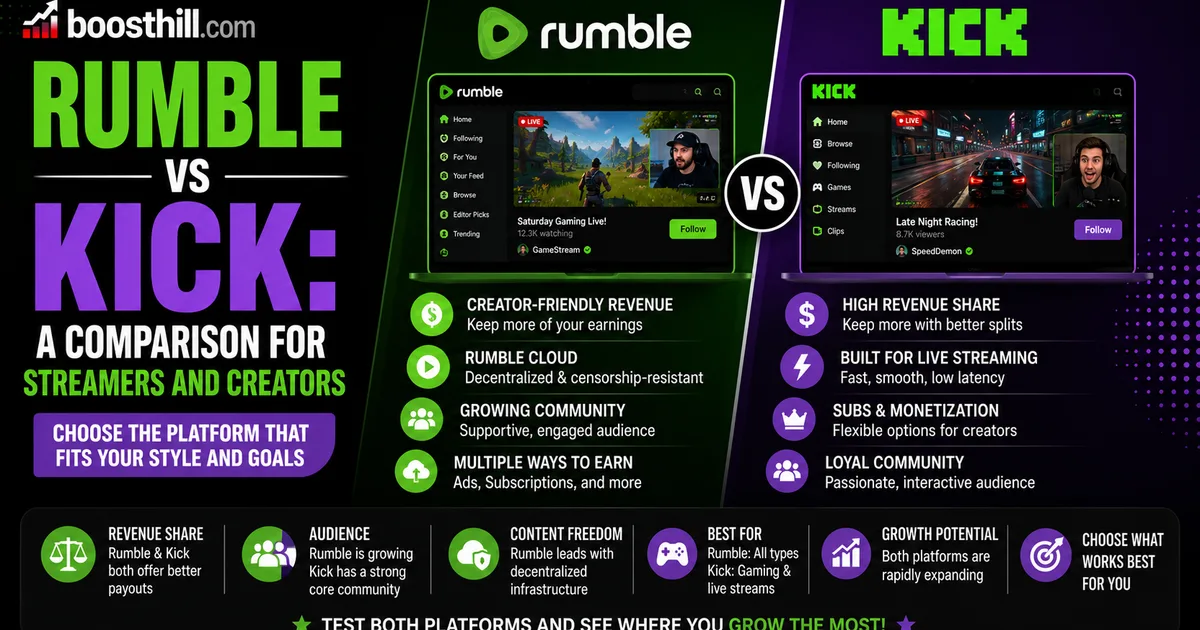
Rumble and Kick are often mentioned in the same breath because both market themselves as creator-friendly alternatives to the established giants. But they are built around different centers of gravity: Kick is primarily a live-streaming platform built to compete with Twitch, while Rumble is a video platform with streaming features that leans toward news, commentary, and uploaded content.
If you are a streamer or creator weighing the two, the useful comparison is about what you actually do day to day, live streaming versus uploads, how each pays, the size and type of audience, and the tools each gives you. Here is a straight look at both.
Core focus: live streaming vs. video platform
Kick is built first and foremost for live streaming. Its layout, chat, and culture revolve around live broadcasts, much like Twitch, and gaming and IRL streams are a big part of its identity. If live is the heart of your content, Kick's product is designed around that.
Rumble supports live streaming too, but it is fundamentally a video platform where uploaded content, news, and commentary play a large role. A creator who mixes uploads with the occasional live stream may find Rumble's broader video focus a better fit, while a dedicated live streamer may feel more at home on Kick.
- Kick: live-streaming first, Twitch-style culture and layout
- Rumble: video platform with streaming as one feature
- Gaming and IRL streams lean Kick; commentary/uploads lean Rumble
- Your day-to-day format should drive the choice
Monetization and revenue splits
Kick drew a lot of attention with a creator-friendly revenue split on subscriptions and a tipping system, which has been a major part of its pitch to streamers. The exact terms and any minimum requirements can change, so confirm the current details before you build a business plan around them.
Rumble offers advertising revenue, subscriptions and tips, and a licensing option for uploaded videos. Its model rewards a different mix of content, and earnings depend on views, advertiser demand, and your niche. As with any platform, treat published payout figures as approximate and expect them to shift over time.
The honest read: Kick's subscription split has been a headline draw for live streamers, while Rumble's strength is a broader set of monetization paths across both live and uploaded video. Neither guarantees income.
Audience and culture
Kick's audience skews toward live entertainment (gaming, just-chatting, and IRL content) and the community behaves much like other live-streaming audiences, with active chat and a focus on real-time interaction.
Rumble's audience leans toward news, politics, and commentary, with a meaningful share of viewers who arrive for uploaded videos rather than live broadcasts. If your content fits that world, Rumble's crowd may be more receptive; if you are an entertainment-focused live streamer, Kick's culture may suit you better.
Tools, reliability, and ecosystem
Both platforms are younger than the incumbents, so their tooling and stability are still maturing relative to the most established competitors. Kick has invested heavily in its streaming stack and creator tools, while Rumble offers a broader video ecosystem that includes hosting, uploads, and distribution.
Consider the practical side: stream stability, mobile experience, clip and VOD handling, and how easy it is to bring your existing audience over. For many creators the deciding factor is simply where their viewers already are, or which platform's format matches their content.
- Kick: focused investment in live-streaming tools
- Rumble: broader video ecosystem (uploads, hosting, distribution)
- Both are still maturing vs. the largest incumbents
- Audience location often decides it more than features
Which is the better fit?
If you are a dedicated live streamer, especially in gaming or IRL. Kick's live-first design and subscription model are built for you. If your content centers on uploads, news, or commentary, or you want a platform that handles both live and on-demand video, Rumble is the more natural home. Plenty of creators experiment with both before committing.
Whichever you pick, a visible follower or subscriber base helps new viewers take your channel seriously when they first land on it. If you want a head start on Rumble specifically, BoostHill delivers channel followers from real, active accounts using only your public link, a credibility nudge that works best alongside a steady streaming and upload schedule, not in place of one.
Frequently asked questions
Read next: Rumble vs YouTube: An Honest Comparison for Creators (2026). For more, browse our Rumble guides or all posts by Jessica Adler.